


I just sent out my Q2 fund update to my investors, and I’m sharing most of it with you below.
I think you’ll find some of the commentary interesting, especially the parallels of today with two specific time periods in history.
As much risk as I see in certain areas of the market, there is an equal amount of opportunity that is being completely ignored right now. Actually, it’s not being ignored… It’s being punished.
That trend will eventually reverse.
Below is most of that update (I’ve removed the fund specific information).
I cannot begin this update without reviewing the macro environment of our world. This isn’t to state the obvious, but instead to document where my head is at and also serve as material that I can reflect on. I’ve found that reading past investment ideas and market thoughts helps put future situations in perspective. Today, in July of 2026, this is especially true.
I’m going to highlight and summarize eight different topics which are all driving markets in different ways and relate to each other to varying degrees.
Artificial intelligence: It’s clear that AI is here and we are starting to get a preview of what the impacts will be. There is no other market theme that even comes close to the current AI narrative. This is important to note, as investors are currently digesting and chasing the different themes that AI will affect. Currently, we seem to be transitioning from the hyperscalers to the memory companies, while the next theme could be anything from biotech, to metals, to energy.
Iran: “What just happened between Iran and the US, and what is going to happen next?” If you asked this question to 100 different people, you’d probably get 100 different answers. There are obvious perspective differences based on political affiliation and general world views, which will influence one’s opinion on the Iran topic. But I believe access and consumption of information is more important than anything else. The reality is that each country, each age group, each political party, and each religious group is getting served a different narrative. Is the war with Iran about nuclear weapons? Is it about oil? Is it about regional security and Israel’s influence? Is it about a bigger picture where the US is attempting to interrupt a larger chess game going on with Russia and China? Or is it all of the above, mixed in with 4th Turning elements? Whichever it is, I believe there is much, much more to come and the market has not even come close to properly processing what is transpiring (especially with energy).
China: The China topic within most US social circles has somewhat disappeared. Taiwan, tariffs, and semiconductor worries have mostly been replaced with Venezuela, Iran, and World Cup debates. I expect the China conversations to reemerge soon.
Latin America: I’ve written about this extensively over the past couple of months. In short, Latin America is swinging right which is mostly favorable for the US. Brazil is the only major country yet to change direction, and it’s possible that they will remain under Lula leadership (or someone similar) during the next election cycle. The entire Latin America story is interesting for two main reasons: 1. There are many undervalued companies that could have real legs if Latin governments allow them to actually run. 2. The strengthening of relations between the US and Latin America provides tailwinds for US industries and challenges for China.
Russia: As I mentioned above about the different information streams related to war, I am no more qualified to analyze the Russia/Ukraine situation than you. Having visited Ukraine multiple times, I have my personal opinions about what’s going on, but in terms of war tactics and likely outcomes I’m just a part of the audience. Recently, it appears that Ukraine is having success using long range drones and weapons within Russia, while Russia has retaliated with strikes on Kyiv residential buildings. The reason I mention this is because this would have been major news in the US media a little while ago. Now, it’s a third page newspaper article. Like the China topic, this war has mostly been forgotten by the US investing community.
Betting: It seems that everywhere I look I see some kind of advertisement for a betting platform. Whether it’s sports, politics, weather, the number of times Elon Musk tweets in a month, or the length of a handshake between Trump and Putin - if you can think of it, you can probably bet on it. I’m not entirely sure what to think of it all. My free-market mind thinks this is healthy and allows information to be publicly debated. But another part of my mind thinks that this is all toxic behavior and is encouraging market participants to expect quick, and large outcomes. Overall, I think that betting culture is a direct result of a younger population simultaneously feeling the need to catch up and lacking patience.
US Monetary Policy: Let me just start with saying that I do not envy Warsh. No matter what he does, or doesn’t do, the critiques will be loud. Without some sort of enormous overhaul, the entire Federal Reserve system is destined to fail. But that could be hundreds of years from now, as the US Federal Reserve does not even rank in the top 30 oldest central banks in the world (the oldest is Sweden’s “Sveriges Riksbank” founded in 1668). Despite the Fed’s relatively youthful age, the Federal Reserve is by far the most important central bank in the world. I am not making a specific prediction, but if there was going to be a material ‘overhaul’ now would be the time. What that overhaul could be is anyone’s guess, but I would argue that the current administration (both outside and inside the Fed) is the most likely to make this happen in a very long time.
Energy and Real World Assets: The closing of the Strait of Hormuz is being called the largest energy supply disruption in the history of the world. Yet, many oil and gas companies are trading for the same price they were a year ago - some companies are actually down year to date. The same can be said for many real world assets, much of which rely on energy to operate or to be manufactured. Some are yelling that the energy market is being manipulated by propaganda and false narratives, which is probably true. Others are arguing that AI will enable the world to extract natural resources much more efficiently and economically, so there is less value in companies tied to commodity prices. Maybe that’s true too.
What you should notice about each of the above topics is that most of them have a highly likely long term result that is being ignored by the market. This situation reminds me of the saying “Do you want to be right, or do you want to make money?” This term was made famous by Ned Davis who wrote the book, Being Right or Making Money. He argued that focusing on predicting the future rather than following what is actually working is how many investors can get themselves in trouble.
While I agree with this sentiment in general, there is a trap that an investor can fall into as they constantly chase what’s working. They become a trader instead of an investor, chasing trends and narratives while ignoring valuations and risks. This chasing eventually requires rapid rollover into new positions that are working, as they panic sell out of positions that are not working. We are seeing this right now with the AI trade, as investors continue to reallocate into (or out of) the next ‘thing’ that AI will disrupt.
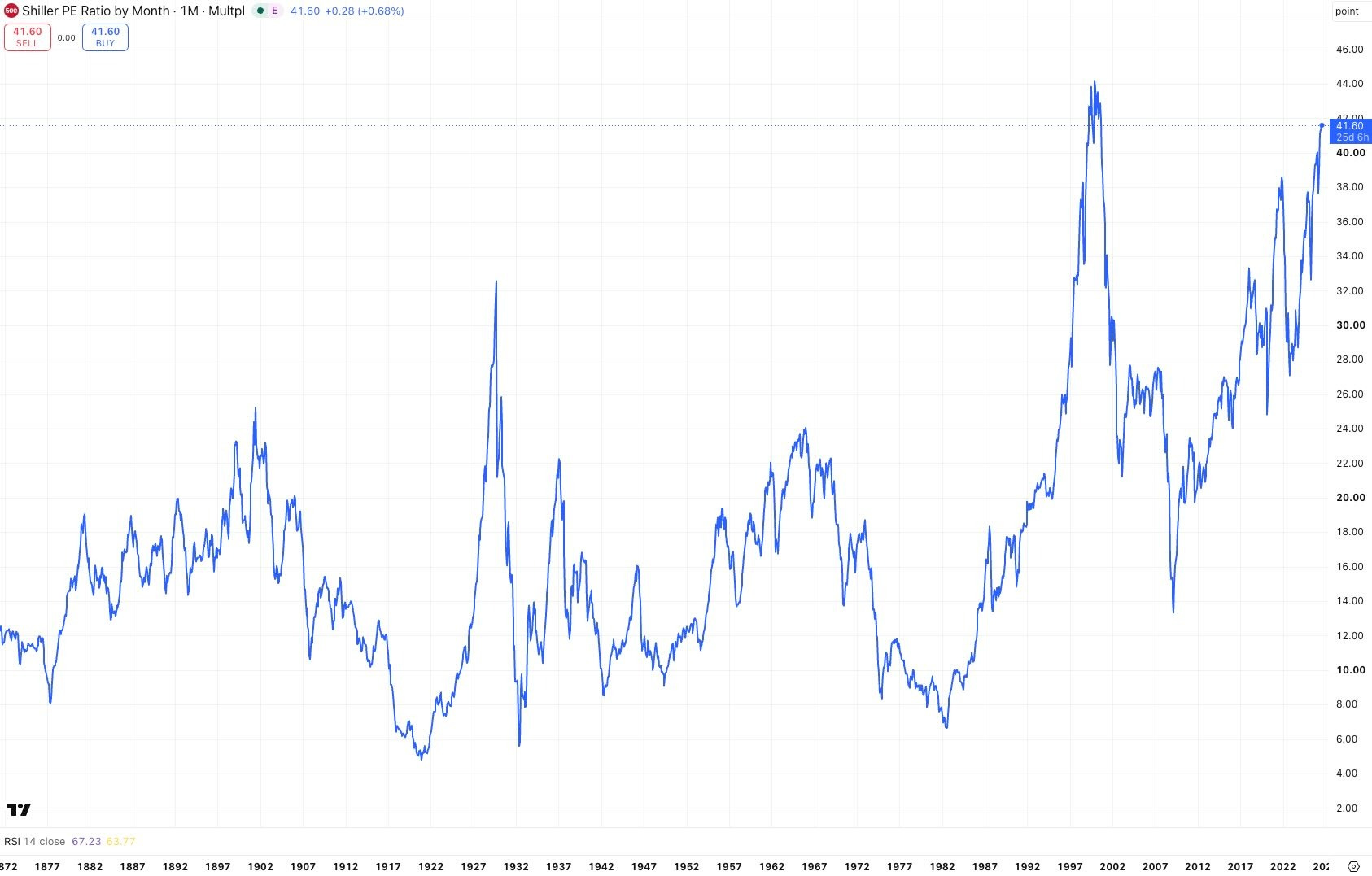
The above historical Shiller PE ratio chart displays this scenario playing out in real time. The current valuation in 2026 is getting pushed close to the dot com era high, and has already far surpassed the 1929 stock market crash.
To help put this all into context, let’s take a quick look back at both prior events to understand this capital rotation phenomenon.
1929: Most people know about Radio Corporation of America (RCA) or Leveraged Investment Trusts that were absolutely wiped out during the 1929 stock market crash. But what often gets ignored are the companies that saw significant draw downs before the crash. Companies within the meatpacking industry, the sugar industry, and the agricultural sector saw enormous drawdowns leading up to 1929, and then went on to see the quickest most dramatic gains once the market recovered.
2000: Again, most people think about all of the dot-com companies that went bust during this time period. Meanwhile, REITs, the financial sector, and consumer staples were beat up badly. Most notably, Berkshire Hathaway saw a ~50% decline from 1998 until the dot com bubble burst on March 11, 2000. Then, from March 11 until December 31 of 2000, Berkshire shares rallied 72% while the Nasdaq fell 51%.
2026: A very similar pattern seems to be materializing with quality companies that are considered boring or irrelevant. As mentioned earlier, energy is a great example as it’s currently the cheapest sector in the market despite recent global supply disruptions and insatiable demand far into the future. Outside of energy, Berkshire has traded sideways for the past year and many consumer staple giants are down 30% or more over the past couple of years.
To be clear, I am not calling for a market crash. Whether highly valued AI related companies can continue their growth story is not what I am focused on. Instead, I am pointing out the high quality companies that the market is choosing to neglect for the time being.
Reach out if you’re an accredited investors and you’d like more information about Catch Swell Capital, L.P.