


In the early 2010’s I traveled extensively throughout Latin America in search of lucrative investment opportunities and great surf.
I’ll save you the tales of secret point breaks controlled by drug cartels for another time, and share the ridiculous real estate deals I found everywhere.
Looking back at this time period it’s difficult to fully explain what was happening with the global property market. Most people think about the widely publicized fall out within the US. Movies like The Big Short highlighted the insanity that led to one of the biggest market bubbles of all time.
But most people don’t think of (or even know) what happened in other countries. It would be a massive understatement to say that there were fire sale prices.
Here are three examples of what I encountered:
El Salvador: Passed on a $30,000 beach front house in El Zonte (now known as “Bitcoin Beach”), which recently sold for $1,200,000.
Peru: Passed on a $65,000 apartment in Punta Hermosa, just south of Lima, which is now listed for $900,000.
Costa Rica: Passed on a $200,000 10 hectare lot of land near Dominical, which is now subdivided into 100 lots of homes that are selling for more than $1 million each!
It’s easy too look back now and have regret, but I know I wouldn’t have ridden that price appreciation journey to where it is now.
But I did get pretty close in Panama…
Price to Sales Ratio in Panama
There’s a remote beach town in Panama that was nothing more than mangroves, mosquitoes, and good waves about 20 years ago.
Then, someone bought a small section of beachfront land and filled in all of the swamp area with dirt and set up a bohemian beach bar. They charged an outrageous $5 per beer and served fried yuca with hot sauce.
This beach front oasis was literally the only game in town and it attracted every surfer and expat jungle creature from a 50 mile radius.
A year later, as the bar got busier, the beers doubled in price.
This went on for a couple more years until an investor came in and paid an obscene price for the lot, which was still the only dry piece of land on the mangrove infested coastline.
This investor didn’t care about the current sales this bar was doing. He just knew he could make a lot more money than the current bar operation.
This story repeated itself at least a dozen times more, over the next couple of years, with beach lots adjacent to the first one.
Each time, an investor would pay an ever higher price for the land, because they knew that the beach front location would pay off.
More people were visiting the beach, more alcohol and food was being sold, and they could continue to raise prices.
It got to a point where these lots, all next to each other on the same stretch of beach, were selling for millions.
The price to sales ratio didn’t matter. The margins and growth just continued to expand.
Then, a big buyer came in.
Price to Sales - It Finally Matters
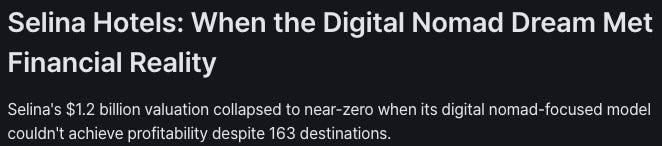
One of those later buyers was Selina Hostels.
They were like the WeWork of global hostels. In fact, one of their earliest investors was Adam Neumann, the founder of WeWork. (I actually met Adam in Panama at the place I am talking about now.)
Selina eventually went public with a $1.2bn valuation.
And then they went bankrupt.
What happened on that Panama beach was a classic story of supply and demand.
The early property buyers were able to print money by having a monopoly over selling beer on the beach.
Then competitors came in, which naturally lowered prices as consumers looked for the best bang for their buck.
The value of each piece of land eventually had to relate to how much money could be made from a business operating there.
In the early stages, the price to sales ratio doesn’t matter. There is enough growth, with huge margins, to justify paying wild prices - the margins and growth would take care of the rest.
But in the later stages, the price to sales ratio is extremely important. There comes a point where growth slows and margins compress.
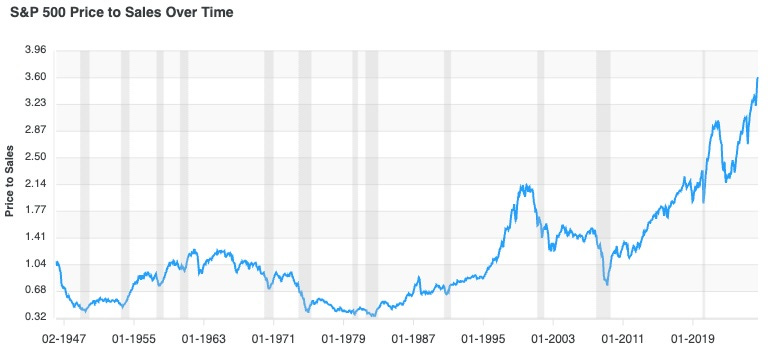
Today, in July of 2026, the price to sales ratio of the S&P 500 is at 3.7 - the highest in recorded history by a long shot.
The question is, where are we at in this cycle?
And, yes, I sold out way too early. I should’ve sold to Selina!