

Is Meta the 21st Century Public Utility?
Just like internet providers in 1999, who will become the gateway to AI?

In the summer of 1999 I discovered Napster, DSL internet, and how to burn a CD.
Just like me, millions of teenagers were discovering how important the internet was going to be. Not because of the high-flying tech stocks of the dot-com boom, but because you could sell pirated music CD’s to your friends at school.
Metallica and Dr. Dre put an end to that short-lived period of time, after they got a federal court order to put Napster out of business. But the cat was out of the bag for any entrepreneurial minded person, no matter their age.
I was lucky that my middle school friend, who happened to live down the street from me, had a father who paid for monthly DSL service. At my house, I had to log onto the internet late at night because the dial up modem would render my parent’s home phone useless.
A DSL internet connection in 1999 felt like shooting fish in a barrel. It didn’t even compare to dial-up.
Your experience with the internet while using a DSL connection was like going to an amusement park with zero lines. Meanwhile, dial-up was like visiting Disneyland during Spring Break with every school bus in the world in the parking lot.
But DSL cost $60 a month and was viewed as a useless luxury service by almost everyone, including my parents.
This is one of those back-in-my-day hard-to-explain stories. Simply put, a fast and reliable internet connection in 1999 was an expensive and useless luxury for most of society.
The Contrarian Tech Play?
Over the past couple of weeks I’ve been building a position in META 0.00%↑.
If you know anything about my investing style, this is probably one of the last companies you’d expect me to invest in.
I’m usually looking for obscure niche opportunities, often in foreign markets.
In short, my thesis with Meta is similar to the one I had with GOOG 0.00%↑ early last year: If this AI thing is real, the big winners will be the ones with the already established distribution networks.
When it comes to Google, it’s easy to see how they will integrate AI into their products. Billions of people use Gmail, YouTube, Android devices, and Gsuite products on a daily basis. Adding an AI layer into these already sticky products will only make the (often times paying) users even stickier.
Now, when you look at Meta, which has 4 billion monthly users across Facebook, Instagram, and WhatsApp, you can see a similar story unfolding.
But the opportunity with Meta may be even bigger.
Meta’s Turning Point?
This morning Zuckerberg published an AI manifesto-esque article titled, The Future is for Everyone.
Although I wouldn’t consider myself a Zuck fan at all, I may be changing my mind. I read the whole thing - it’s very good. You should read it too.
Before I explain the important parts of his views on AI, let’s look at Meta’s performance over the past two years. Their share price has essentially gone sideways.
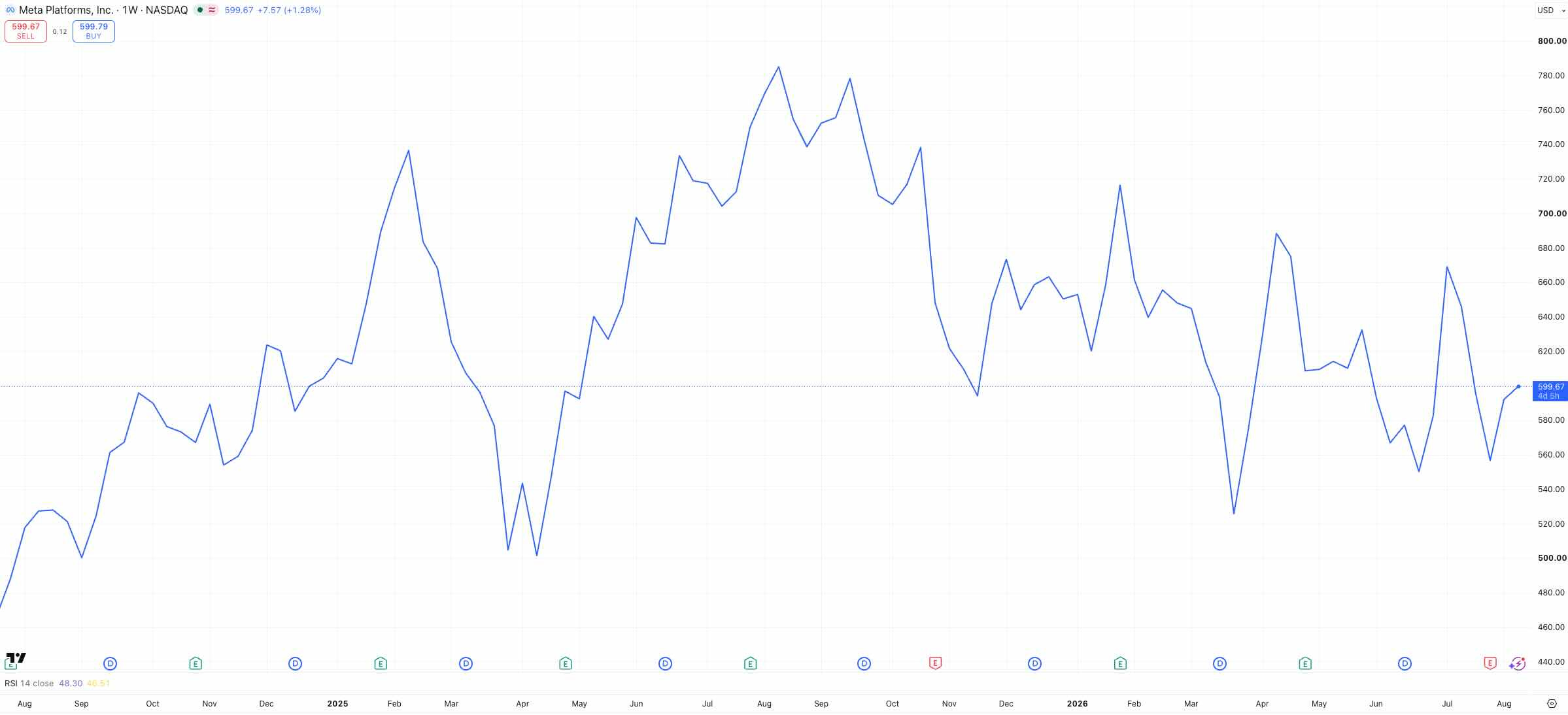
Their stock price is down 20% over the past year and down 10% year to date.
When you compare Meta to all of its peers, its really the only one that has underperformed.
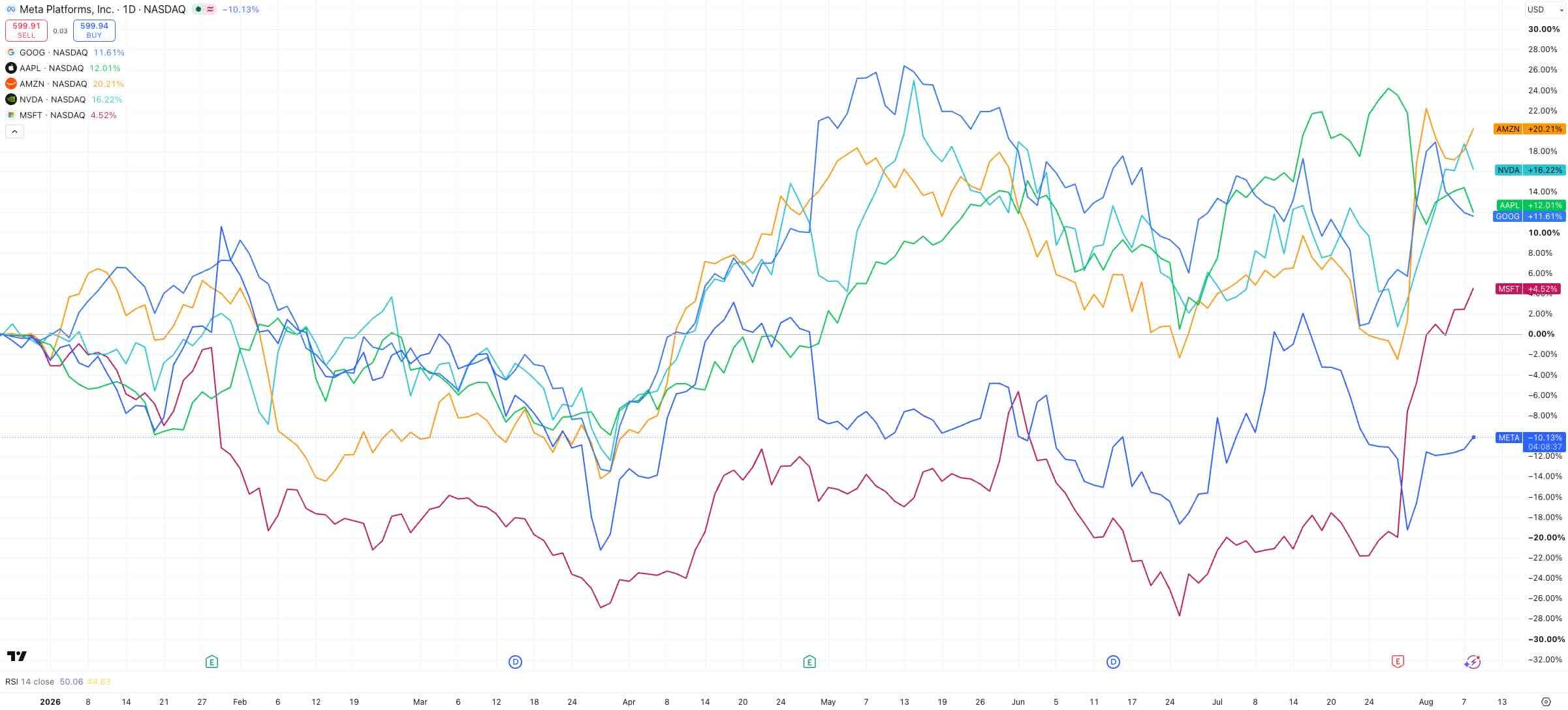
Google, Amazon, Nvidia, Apple, and Microsoft have done better.
Is it time for Meta to catch up?
Meta Coming Back to Life?
I read Zuck’s article as a free-market, pro-capitalism, pro-America, anti-government tyranny proclamation.
One of the sections of his article is even titled Protecting Freedom and Preventing Government Tyranny.
I agree with it all.
But it’s not just his macro views about AI that I agree with. I also think what he has planned with Meta is a smart move.
It reminds me of that time when an internet connection went from a luxury to a requirement.
In his section about what Meta has planned, his first and last bullet points are most important:
Everyone will have an exceptionally capable personal agent that understands you, your goals, and everything you care about. Your agent will work 24/7 on your behalf to improve your relationships, health, career, finances, home management, hobbies, and more. It will free up time for the things you enjoy, and help you accomplish more than you could otherwise. It will have strong privacy and security options so you can trust it to handle all of your personal content knowing that no one else can access your information, similar to how encryption works on WhatsApp. You'll be able to interact with your agent through any device, including your glasses to keep you present in the moment with the people you care about.
Everyone will have free or affordable access to these tools. For everyone to be part of the future, everyone must have the ability to use superintelligence to improve their lives and shape the world. We will offer free versions that will be accessible to billions of people. For those who want to pay to use more compute, there will be a dynamic auction mechanism that will guarantee that everyone gets the lowest price possible for the intelligence and compute they’re using while also ensuring the capacity is used for whatever people collectively find most valuable. This will ensure the benefits of superintelligence are distributed widely.
Zuck is basically saying that Meta is going to be providing AI services to people, as if it’s a utility. And Meta is that utility provider that already has billions of users.
AI - The Next Must Have Utility?
So, my question for you is:
Do you see AI playing out as a utility, just like the internet has evolved from a luxury to a requirement?
If so, are the utility providers tech companies (like Google and Meta) or the infrastructure players (like compute and memory)? Maybe both?
Is an investment in Meta a bet that AI will become an everyday tool that people around the world will rely on?
Beyond these questions, I think Meta’s recent underperformance is interesting on its own.
And to Zuck: Keep preaching your beliefs. If your most recent statements are true, and you’ve moved beyond being a weathervane to political pressure, keep going!